why this blog?

Likelihood Ratio (LR) in Emergency Medicine
Showing posts with label infection. Show all posts

8/20/2012

Cellulitis and the role of laboratory


Clinical Scenario

A 72 y/o woman presented to the ED for swollen and painful leg.
Physical examination shows an erythematous, tender and warm leg. 
Probably it is a cellulitis. 
In previous post we stressed the US use to increase diagnostic accuracy. 


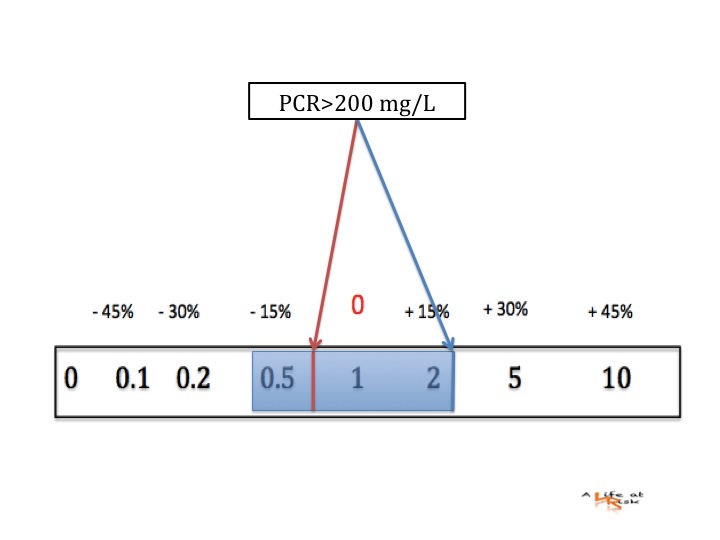
Can WBC or CPR help in the differential diagnoses?  
Do they have a role in the decision to admit the patient to the Hospital?  


Read more...

4/05/2012

Diagnosis of pneumonia. Is it the time for a combined imaging strategy?

A 80 yo man is brought from an assisted-living facility because of fever, productive cough, tachycardia and dyspnoea. 
He has a history of dementia and hypertension.
He is cachectic, you hear ronchi on the left side. 


How should you approach this patient?

Read more...

1/26/2012

Septic Arthritis and Arthrocentesis

A 33 y/o male comes to the ED for fever, knee swelling and pain.
He has a history of joint surgery because of trauma, and prothesis, dating 4 years before.
He is HIV positive
He presents feverish (38°C), the left knee is swollen and hot.
WBC 34.000/μL, CRP 109 mg/L, PCT 0,05 ng/mL.
As we have seen in previous post, history, clinical examination and serum test are not useful to rule out or in a septic arthritis. It’s time to perform arthrocentesis: sWBC: 60x109, sLactate: 10 mmol/L


Are this findings useful?


Conclusion 

Although arthrocentesis is not a risk-free procedure, synovial fluid analysis is essential for the diagnosis. 
sWBC count has been studied in several trials but a significant heterogeneity was noted so it should not be used in isolation to rule in or rule out the diagnosis of septic arthritis, anyway it should augment the entire clinical evaluation.
Synovial lactate, instead, has consistently demonstrated desirable diagnostic properties to rule in septic arthritis using a threshold of >10 mmol ⁄ L. 


Bibliography 

C. R. Carpenter et al;
Evidence-based Diagnostics: Adult Septic Arthritis
Acad Emerg Med Aug 2011, vol 18 n 8. 

see previous...


Ilenia Spallino

Read more...

1/18/2012

Septic Arthritis

A 33 y/o male comes to the ED for fever, knee swelling and pain.
He has a history of joint surgery because of trauma, and prothesis, dating 4 years before.
He is HIV positive
He presents feverish (38°C), the left knee is swollen and hot.
WBC 34.000/μL CRP 109 mg/L PCT 0,05 ng/mL


Are history, clinical examination, serum test enough to rule out or in a septic arthritis?


Conclusion 

No finding from the history significantly decreases or increase the probability of septic arthritis (SA), included hystory of HIV infection; only recent joint surgery (<3 months ago) or a joint prosthesis with skin infection, significantly increases the risk of septic arthritis, but attention, the absence does not rule out SA!
Data about physical examination and hystory are inconcludent, the presence or absence of classical clinical signs (pain with motion, limited motion, tender swelling, joint effusion, increased heat redness, fever > 37.5°C, axial load pain) is not useful to rule in or rule out septic arthritis.
Serum test like WBC, ESR, CRP are not useful, instead Procalcitonin is generally specific with very poor sensitivity. 
…..So what?


Bibliography 

C. R. Carpenter et al;
Evidence-based Diagnostics: Adult Septic Arthritis
Acad Emerg Med Aug 2011, vol 18 n 8. 


Ilenia Spallino

Read more...

1/08/2012

Soft tissue abscess: clinical plus ultrasound evaluation

Male 65 y/o, he complains pain and swelling in left groin, he has history of hypertension. He has not fever. Clinical examination shows swelling, skin is hot and  eritematous.


Is it an abscess, a cellulitis or something else? 


Conclusion 


To use ultrasound on eritematous and swelling skin is very helpful 
Abscesses presents as a spherical structure with “pus in movement”.  
Celluliti’s morphology, instead, has a “cooblestoning effect”, with diffuse hyperechogenicity of subcutaneous fat.

Ultrasonography is a useful adjunct to clinical evaluation of soft tissue infection, it increases diagnostic accuracy and guides treatment decision.


Bibliography 

BT Squire, JC Fox, C Anderson
ABSCESS: applied bedside sonography for convenient evaluation of superficial soft tissue infections
Acad Emerg Med July 2005, Vol. 12, No. 7 

DW Struk, PL Munk
Imaging of softs tissue infections
Radiol Clin of N Am vol 39 n2 Mar 2001


Ciro Paolillo


Read more...

12/14/2011

Soft tissue abscess the clinical evaluation

Male 65 y/o, he complains pain and swelling in left groin, he has history of hypertension. He has not fever. Clinical examination shows swelling, skin is hot and eritematous.


Is it an abscess, a cellulitis or something else?


Conclusion 

Differentiating a soft tissue abscess from cellulitis is important because each disorder requires a different treatment.
Clinical examination alone has small role for this scope.
May we need something else?


Bibliography 

BT Squire, JC Fox, C Anderson
ABSCESS: Applied Bedside Sonography for Convenient Evaluation of Superficial Soft Tissue Infections
ACAD EMERG MED July 2005, Vol. 12, No. 7 


Ciro Paolillo


Read more...

8/23/2011

Clinical Signs and Meningitis


It’s 4 in the morning when a 23 y/o female comes to the ED concerning bilteral legs pain and disuria.
She has not clinical history, she has fever, the pain is bilteral and diffused, “the whole leg pains” and she has difficult in urine, you think about a radiculopathy due to possible neuro system infection (fever, bilateral pain and sphyncter disfuntion)
physics examination is completely normal.
Kerning and Bruzinsky are negative, and she has not rigor nucalis.


Can you rule out a meningitis?


Conclusion 

No physical sign of meningeal irritation could accurately distinguish those with and without meningitis: nuchal rigidity (LR+ 1.33 (0.89, 1.98) and LR- 0.86 (0.70, 1.06)), Kernig's sign (LR+ 1.84 (0.77, 4.35) and LR- 0.93(0.84, 1.03)) and Brudzinski's sign (LR+ 1.69 (0.65, 4.37) and LR- 0.95 (0.87, 1.04))
The sensitivity of Kernig’s and Brudzinski’s signs was first established nearly 100 years ago for patients with severe bacterial or tuberculous meningitis. Althought Brudzinski’s signs can identify patients with severe meningeal inflammation, these diagnostic tools are too insensitive to identify the majority of patients with meningitis in con- temporary practice (including patients with microbiologically treatable disease). Clinical decisions regarding further diag- nostic testing and the need for a lumbar puncture should not rely solely on the presence or absence of these meningeal signs. Better bedside diagnostic tests are needed


Bibliography 

Accuracy of physical signs for detecting meningitis: a hospital-based diagnostic accuracy study. 
Clin Neurol Neurosurg. 2010 Nov;112(9):752-7. Epub 2010 Jul. Waghdhare S, Kalantri A, Joshi R, Kalantri S.

The Diagnostic Accuracy of Kernig’s Sign, Brudzinski’s Sign, and Nuchal Rigidity in Adults with Suspected Meningitis 
Med Mal Infect. 2009 Jul-Aug;39(7-8):445-51. 

Sensitivity and specificity of clinical signs in adults. 
Karen E. Thomas,1 Rodrigo Hasbun,1 James Jekel,2 and Vincent J. Quagliarello1


Ilenia Spallino


Read more...

7/12/2011

CD4 and Lymphocyte count

A 30 yo man from Zambia comes to the ED accompained by his girlfriend, he is HIV positive and he has pneumonia, he never done CD4 count. CD4 count of < 200 signifies a greater risk for opportunistic infections = recovery. I can’t  wait for the reponse of the CD4 count…


How much an absolute lymphocite count (ALC) is predictive for a low CD4 count (< 200)?


Conclusion 

Absolute lymphocyte count was predictive of a CD4 count of <200 · 106 cells ⁄ lL in HIV+ patients who present to the ED, necessitating hospital admission. A CD4 count of <200 · 106 cells ⁄ lL is very likely if the ED ALC is <950 · 106 cells ⁄ lL and less likely if the ALC is >1,700 · 106 cells ⁄ lL.


Bibliography

Absolute Lymphocyte Count in the Emergency Department Predicts a Low CD4 Count in Admitted HIV-positive Patients. Napoli AM Acad Emerg Med 2011; 18:385-389

Acute HIV infection: diagnosis and management in the Emergency Department. Wesley HS. Emerg Med Clin N Am 28 (2010) 381–392.

HIV infection and complications in Emergency Medicine. Marco CA. Emerg Med Clin N Am 26 (2008) 367-387

Ciro Paolillo


Read more...