why this blog?

Likelihood Ratio (LR) in Emergency Medicine
Showing posts with label blood test. Show all posts

1/01/2016

Blood test and urgent abdominal conditions


Clinical Scenario


A 44 YO man presents to the ED complaining of abdominal pain. He was well until 4 hours ago, when he developed diffuse abdominal pain. This is the first time he suffers abdominal pain. He has not history of surgery.
The patient is afebrile, HR is 80, BP is 180/100, ECG is normal. The abdomen is very painful, but soft.
Is it a serious condition? Asks the worried man.
“We’ll see later, after blood test” says the doctor. 


Conclusion 

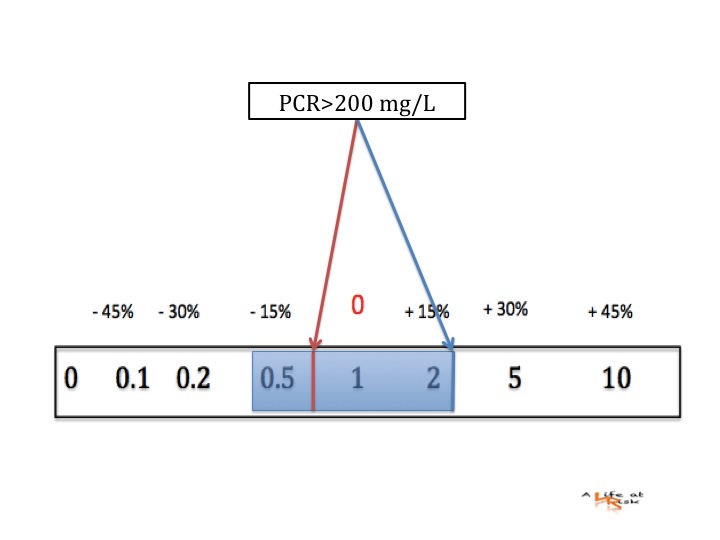
WBC count and CRP levels alone or together are insufficient markers to be used as a triage instruments to select an urgent from non-urgent abdominal condition. In several circumstances like acute appendicitis or acute diverticulitis o cholecystitis WBC count and CRP levels can be normal.
Blood test alone are of limited use. 


Bibliography 

SL Gans
Medicine 2015 vol 94 n 9 1-9.

C Paolillo, I.Spallino

Intern Emerg Med 2015 oct 27.


Ciro Paolillo
Read more...

10/04/2012

Does procalcitonin have a role in the management of acute appendicitis?


Clinical scenario
A 18 yo man comes to the ED in the morning because of low abdominal pain, fever and nausea. At palpation there is mild pain in the right inferior quadrant, not guarding.


Could procalcitonin (PTC) helps to exclude quickly an acute appendicitis?

Read more...

8/20/2012

Cellulitis and the role of laboratory


Clinical Scenario

A 72 y/o woman presented to the ED for swollen and painful leg.
Physical examination shows an erythematous, tender and warm leg. 
Probably it is a cellulitis. 
In previous post we stressed the US use to increase diagnostic accuracy. 


Can WBC or CPR help in the differential diagnoses?  
Do they have a role in the decision to admit the patient to the Hospital?  


Read more...

5/28/2012

Is CRP correlated to CT result in the evaluation of abdominal pain?


A 74 yo/man complained of diffuse abdominal pain. The pain was intermittent and accompained by vomiting. He has no history of abdominal pain or abdominal surgery.
On examinations the patient presented non icteric, afebrile, not tachicardic. 
The abdomen was mildly distensed with midline tenderness. 
The US evidenced a normal aorta diameter. 
Abdominal x ray showed non specific bowel gas pattern. 
CRP value was 7 mg/L.


The radiologist says it is a little value to perform an abdominal CT, we see tomorrow…..

Read more...

1/18/2012

Septic Arthritis

A 33 y/o male comes to the ED for fever, knee swelling and pain.
He has a history of joint surgery because of trauma, and prothesis, dating 4 years before.
He is HIV positive
He presents feverish (38°C), the left knee is swollen and hot.
WBC 34.000/μL CRP 109 mg/L PCT 0,05 ng/mL


Are history, clinical examination, serum test enough to rule out or in a septic arthritis?


Conclusion 

No finding from the history significantly decreases or increase the probability of septic arthritis (SA), included hystory of HIV infection; only recent joint surgery (<3 months ago) or a joint prosthesis with skin infection, significantly increases the risk of septic arthritis, but attention, the absence does not rule out SA!
Data about physical examination and hystory are inconcludent, the presence or absence of classical clinical signs (pain with motion, limited motion, tender swelling, joint effusion, increased heat redness, fever > 37.5°C, axial load pain) is not useful to rule in or rule out septic arthritis.
Serum test like WBC, ESR, CRP are not useful, instead Procalcitonin is generally specific with very poor sensitivity. 
…..So what?


Bibliography 

C. R. Carpenter et al;
Evidence-based Diagnostics: Adult Septic Arthritis
Acad Emerg Med Aug 2011, vol 18 n 8. 


Ilenia Spallino

Read more...

11/23/2011

Intestinal Ischemia and Lactate

A 84 y/o woman comes accompained by relatives for abdominal pain.
She is oriented and cooperative, she suffers pain (NRS 10/10).
Abdomen is treatable, but very painful in the lower quadrants, you see green watering diarrhea, she has not fever.
Abdominal Radiograph shows air/fluid levels
WBC: 35000/μl PCR: 22 mg/L Lactate: 1,7


Can you rule out intestinal ischemia?


Conclusion 

The performance of lactate and other serological markers is disappointing and not particularly helpful to rule out intestinal ischemia.


Bibliography 

NJ Evennett, MS Petrov, A Mittal, JA Windsor
Systematic Review and Pooled Estimates for the Diagnostic Accuracy of Serological Markers for Intestinal Ischemia
World J Surg (2009) 33:1374–1383 


Ilenia Spallino

Read more...

7/12/2011

CD4 and Lymphocyte count

A 30 yo man from Zambia comes to the ED accompained by his girlfriend, he is HIV positive and he has pneumonia, he never done CD4 count. CD4 count of < 200 signifies a greater risk for opportunistic infections = recovery. I can’t  wait for the reponse of the CD4 count…


How much an absolute lymphocite count (ALC) is predictive for a low CD4 count (< 200)?


Conclusion 

Absolute lymphocyte count was predictive of a CD4 count of <200 · 106 cells ⁄ lL in HIV+ patients who present to the ED, necessitating hospital admission. A CD4 count of <200 · 106 cells ⁄ lL is very likely if the ED ALC is <950 · 106 cells ⁄ lL and less likely if the ALC is >1,700 · 106 cells ⁄ lL.


Bibliography

Absolute Lymphocyte Count in the Emergency Department Predicts a Low CD4 Count in Admitted HIV-positive Patients. Napoli AM Acad Emerg Med 2011; 18:385-389

Acute HIV infection: diagnosis and management in the Emergency Department. Wesley HS. Emerg Med Clin N Am 28 (2010) 381–392.

HIV infection and complications in Emergency Medicine. Marco CA. Emerg Med Clin N Am 26 (2008) 367-387

Ciro Paolillo


Read more...

5/17/2011

D-dimer and Aortic dissection


It’s 3.00 am when a 55 yo man is accompained to the ED by his wife because of sudden onset precordial pain, he has not clinical history, he does not smoke and he has an active life style, you find a normal blood pressure and clinical examination and a normal ECG, but the pain is severe and continuos. The patient start sweating, and you too. You give morfine and start thinking about….AORTA! you don’t find any pulse difference, but your feeling increases, how can you explain your feeling to the radiologist? 

Can something else help you to rule-out aortic dissection….


Conclusion

The presence of pulse deficits or focal neurological deficits increases the likelihood of an acute thoracic aortic dissection in the appropriate clinical setting. Conversely, a completely normal chest radiograph result or the absence of pain of sudden onset lowers the likelihood. Overall, however, the clinical examination is insufficiently sensitive to rule out aortic dissection given the high morbidity of missed diagnosis.

A negative D-dimer (<500) can rule-out an aortic dissection.
Unfortunately a positive test does not give any additional chance to persuade radiologist…


Bibliography

Epidemiology of thoracic aortic dissection. LeMaire SA, Russell L. Nat Rev Cardiol. 2011 Feb;8(2):103-13. Epub 2010 Dec 21.

Does this patient have an acute thoracic aortic dissection? Klompas M. JAMA. 2002 May 1;287(17):2262-72.

Meta-analysis of usefulness of d-dimer to diagnose acute aortic dissection. Shimony A, Filion KB, Mottillo S, Dourian T, Eisenberg MJ. Am J Cardiol. 2011 Apr 15;107(8):1227-34. Epub 2011 Feb 4.

D-dimer in ruling out acute aortic dissection: a systematic review and prospective cohort study. Eur Heart J. 2007 Dec;28(24):3067-75. Epub 2007 Nov 6. Sodeck G, Domanovits H, Schillinger M, Ehrlich MP, Endler G, Herkner H, Laggner A.

D-dimer as the sole screening test for acute aortic dissection: a review of the literature. Sutherland A, Escano J, Coon TP. Ann Emerg Med. 2008 Oct;52(4):339-43.

Diagnostic and prognostic value of circulating D-Dimers in patients with acute aortic dissection. Ohlmann P, Faure A, Morel O, Petit H, Kabbaj H, Meyer N, Cheneau E, Jesel L, Epailly E, Desprez D, Grunebaum L, Schneider F, Roul G, Mazzucotteli JP, Eisenmann B, Bareiss P. Crit Care Med. 2006 May;34(5):1358-64. 


Ilenia Spallino


Read more...