why this blog?

Likelihood Ratio (LR) in Emergency Medicine
Showing posts with label LR. Show all posts

12/08/2012

Atypical or typical, is this the question?


Clinical Scenarios

It is a busy day in your ED:


A 60 y/o female refers a retrosternal pain radiates to right arm that lasts more than 20 minutes. 

A 50 y/o male refers a pressure  in his chest, with tachycardia and sweating.

A 75 y/o female refers a sharp and stabbing pain exacerbates by forceful breathing.

In all cases the ECGs are nondiagnostic.
Do these clinical features help to predict an acute myocardial infarction (AMI)?


Read more...

11/17/2012

Pleuritic Pain, the end of the saga...


Clinical Scenario

A 33 y/o woman, comes to the ED because of a sudden emithorax pain on the left in basal region. The pain is described as stabbing, well localized, it worsen with inspirium …a pleuritic pain, no cough, no fever, not hemoptysis. She smokes, she does not take any medication. 
Chest x ray is normal. You receive blood test: WBC 7.500/mcL, CRP 20 mg/dl , D-dimer 603 ng/ml

We have seen in the previous post that we can’t rule out the possibility to find a radio-occult lesion based on our blood test, but on the other hand specificity is poor, so what are we looking for?
What does pleuritic pain means? 
If you ask wikipedia… the answer is frightful…


What if you ask to your probe?

Read more...

10/27/2012

What does it hide behind a negative X-Ray?


Clinical Scenario

A 33 y/o woman, comes to the ED because of a sudden emithorax pain on the left in basal region. The pain is described as stabbing, well localized, it worsen with inspirium …a pleuritic pain, no cough, no fever, not hemoptysis. She smokes, she does not take any medication. 
Chest x ray is normal. You receive blood test: WBC 7.500/mcL, CRP 20 mg/dl , D-dimer 603 ng/ml.


Maybe is not a wall chest pain, but in which direction this test are carrying you?


Read more...

10/11/2012

Pleuritic pain and radio-occult lesion

Clinical Scenario

A 33 y/o woman, comes to the ED because of a sudden emithorax pain localized on the left in basal region. The pain is described as stabbing, well localised, it worsen with inspirium …a pleuritic pain, no cough, no fever, not hemoptysis. She smokes, she does not take any medication. Chest x ray is normal. 


Is it a wall chest pain or there migth be something else? 


Read more...

8/20/2012

Cellulitis and the role of laboratory


Clinical Scenario

A 72 y/o woman presented to the ED for swollen and painful leg.
Physical examination shows an erythematous, tender and warm leg. 
Probably it is a cellulitis. 
In previous post we stressed the US use to increase diagnostic accuracy. 


Can WBC or CPR help in the differential diagnoses?  
Do they have a role in the decision to admit the patient to the Hospital?  


Read more...

7/02/2012

Thoracic trauma and chest X-Ray


Clinical Scenario

You are alerted for a level 3 trauma coming from the mountain, a cyclist has fallen going down hill.
You prepare the shock room with everything you may need, dress up, and wait.
A 25 y/o cyclist arrives completely immobilized, you immediately start to  perform ABCDE as you learned in your recent ATLS course (...you feel confident).
First stop is a possible problem in “B” (breathing): he has an ecchimosis on the right emithorax, not crepitation, maybe there is a less vescicular murmur on the same side, but you are not sure (the shock room is very crowded an noisy!), he is slightely tachypnoic (RR is 24), O2 saturation is 96%. …you go on….in “E” (Exposure) you find an exposed, bleeding, thigh bone fracture that surly is going to need surgery, at the moment you stop the bleeding, stabilize, allert orthopedic…ect…
FAST is normal. You ask for X-Ray: anteroposterior (AP) chest x-ray, pelvis and thigh bone. Radiologist confirms exposed fracture, no signs of pneumothorax, surgery room is ready...


…Do you still feel confident?

Read more...

6/28/2012

Chest X-Ray and aortic dissection

Clinical Scenario 
A 70 yo man come to the ED for restrosternal chest pain and shortness of breath during minimal activity in the last days. He is an ex smoker, with a history of hypertension. On physical examination the patient is not in distress, with a regular blood pressure and regular oximetry. ECG shows no evidence of ischemia. You first think about coronary artery disease, but you also want to exclude an aortic dissection. In Radiology the patient remaine seated and receive an anteroposterior (AP) chest Xray: maximal mediastinal width (MW) is 8,80 cm (the optimal cutoff level is 8,65 cm), no other signs. 


Shall you worry?

Read more...

5/28/2012

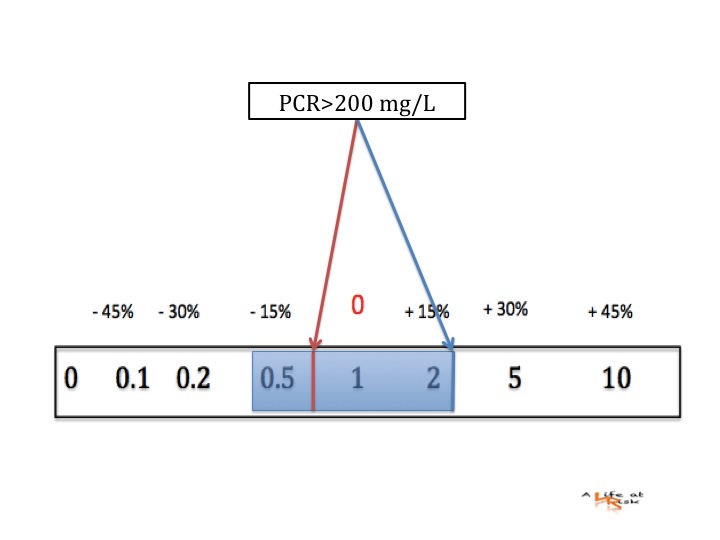
Is CRP correlated to CT result in the evaluation of abdominal pain?


A 74 yo/man complained of diffuse abdominal pain. The pain was intermittent and accompained by vomiting. He has no history of abdominal pain or abdominal surgery.
On examinations the patient presented non icteric, afebrile, not tachicardic. 
The abdomen was mildly distensed with midline tenderness. 
The US evidenced a normal aorta diameter. 
Abdominal x ray showed non specific bowel gas pattern. 
CRP value was 7 mg/L.


The radiologist says it is a little value to perform an abdominal CT, we see tomorrow…..

Read more...

5/01/2012

How LR works. Why any test is unnecessary for a patient with very low-risk chest pain ?

A 40 yo truck driver, presented in ED with substernal chest pain. He is healthy, no family history of CAD. Held for observation, serial ECG have not modified, not elevated troponin.


Is an Exercise Treadmill Testing useful (ETT)? Or a Myocardial Perfusion Imaging (MPI) is better ?

Read more...

1/26/2012

Septic Arthritis and Arthrocentesis

A 33 y/o male comes to the ED for fever, knee swelling and pain.
He has a history of joint surgery because of trauma, and prothesis, dating 4 years before.
He is HIV positive
He presents feverish (38°C), the left knee is swollen and hot.
WBC 34.000/μL, CRP 109 mg/L, PCT 0,05 ng/mL.
As we have seen in previous post, history, clinical examination and serum test are not useful to rule out or in a septic arthritis. It’s time to perform arthrocentesis: sWBC: 60x109, sLactate: 10 mmol/L


Are this findings useful?


Conclusion 

Although arthrocentesis is not a risk-free procedure, synovial fluid analysis is essential for the diagnosis. 
sWBC count has been studied in several trials but a significant heterogeneity was noted so it should not be used in isolation to rule in or rule out the diagnosis of septic arthritis, anyway it should augment the entire clinical evaluation.
Synovial lactate, instead, has consistently demonstrated desirable diagnostic properties to rule in septic arthritis using a threshold of >10 mmol ⁄ L. 


Bibliography 

C. R. Carpenter et al;
Evidence-based Diagnostics: Adult Septic Arthritis
Acad Emerg Med Aug 2011, vol 18 n 8. 

see previous...


Ilenia Spallino

Read more...

1/18/2012

Septic Arthritis

A 33 y/o male comes to the ED for fever, knee swelling and pain.
He has a history of joint surgery because of trauma, and prothesis, dating 4 years before.
He is HIV positive
He presents feverish (38°C), the left knee is swollen and hot.
WBC 34.000/μL CRP 109 mg/L PCT 0,05 ng/mL


Are history, clinical examination, serum test enough to rule out or in a septic arthritis?


Conclusion 

No finding from the history significantly decreases or increase the probability of septic arthritis (SA), included hystory of HIV infection; only recent joint surgery (<3 months ago) or a joint prosthesis with skin infection, significantly increases the risk of septic arthritis, but attention, the absence does not rule out SA!
Data about physical examination and hystory are inconcludent, the presence or absence of classical clinical signs (pain with motion, limited motion, tender swelling, joint effusion, increased heat redness, fever > 37.5°C, axial load pain) is not useful to rule in or rule out septic arthritis.
Serum test like WBC, ESR, CRP are not useful, instead Procalcitonin is generally specific with very poor sensitivity. 
…..So what?


Bibliography 

C. R. Carpenter et al;
Evidence-based Diagnostics: Adult Septic Arthritis
Acad Emerg Med Aug 2011, vol 18 n 8. 


Ilenia Spallino

Read more...

11/23/2011

Intestinal Ischemia and Lactate

A 84 y/o woman comes accompained by relatives for abdominal pain.
She is oriented and cooperative, she suffers pain (NRS 10/10).
Abdomen is treatable, but very painful in the lower quadrants, you see green watering diarrhea, she has not fever.
Abdominal Radiograph shows air/fluid levels
WBC: 35000/μl PCR: 22 mg/L Lactate: 1,7


Can you rule out intestinal ischemia?


Conclusion 

The performance of lactate and other serological markers is disappointing and not particularly helpful to rule out intestinal ischemia.


Bibliography 

NJ Evennett, MS Petrov, A Mittal, JA Windsor
Systematic Review and Pooled Estimates for the Diagnostic Accuracy of Serological Markers for Intestinal Ischemia
World J Surg (2009) 33:1374–1383 


Ilenia Spallino

Read more...